
TL;DR:
- Fitness should be personalized, accessible, consistent, and enjoyable for all ages.
- Exercise routines vary by age but include aerobic, strength, balance, and flexibility activities.
- Overcoming barriers and adapting exercises helps everyone maintain health and independence.
Fitness isn’t just for the young, the athletic, or the injury-free. Whether you’re a busy parent in Davisville, a senior looking to stay independent, or someone rebuilding strength after an injury, physical activity tailored to you can improve your health, prevent disease, and help you feel your best. Toronto’s fitness landscape is more inclusive than ever, and this guide gives you the practical, evidence-based direction you need to move well at every stage of life.
Table of Contents
- Key principles of fitness for all ages
- Recommended exercise routines by age group
- Types of exercises for a well-rounded fitness plan
- Overcoming barriers and adapting fitness for all abilities
- Why true fitness goes beyond age brackets
- Supporting your Toronto fitness journey with inclusive resources
- Frequently asked questions
Key Takeaways
| Point | Details |
|---|---|
| Tailored activity matters | Fitness must be adapted to age, ability, and health status for best outcomes. |
| All ages benefit | Regular exercise supports disease prevention, physical independence, and mental wellbeing at every life stage. |
| Toronto offers inclusive choices | Local gyms, trainers, and public spaces provide resources for everyone, including beginners and seniors. |
| Guidelines drive results | Evidence-based recommendations from CDC and WHO ensure safety and progress across age groups. |
Key principles of fitness for all ages
Fitness for all ages means regular physical activity that is shaped around your age, ability, and health conditions. It is not a one-size-fits-all programme. It is a personalised approach that evolves as you do.
Leading health authorities agree on the core idea: movement should be accessible, consistent, and purposeful. The CDC Physical Activity Guidelines outline how activity needs shift across the lifespan, from daily play for preschoolers to balance training for older adults. The WHO age-specific recommendations go further, addressing physical activity for people with chronic conditions, disabilities, and those who are pregnant, while also emphasising the importance of reducing sedentary behaviour at every age.
Here are the foundational principles that apply across all age groups:
- Consistency over intensity: Regular movement, even at low intensity, delivers lasting health benefits.
- Progression: Gradually increasing effort prevents injury and builds capacity over time.
- Variety: Combining aerobic, strength, balance, and flexibility work creates well-rounded fitness.
- Adaptation: Routines must be modified for health conditions, recovery stages, and personal goals.
- Enjoyment: Sustainable fitness happens when you actually like what you are doing.
“The greatest barrier to fitness is not age or ability. It is the belief that movement must look a certain way to count.”
Toronto offers a wide range of accessible wellness resources, from community centres with adaptive programmes to boutique gyms that specialise in personalised training. No matter where you are starting from, there is a path forward.
Recommended exercise routines by age group
Building on those principles, let’s look at what the evidence actually recommends for each stage of life.
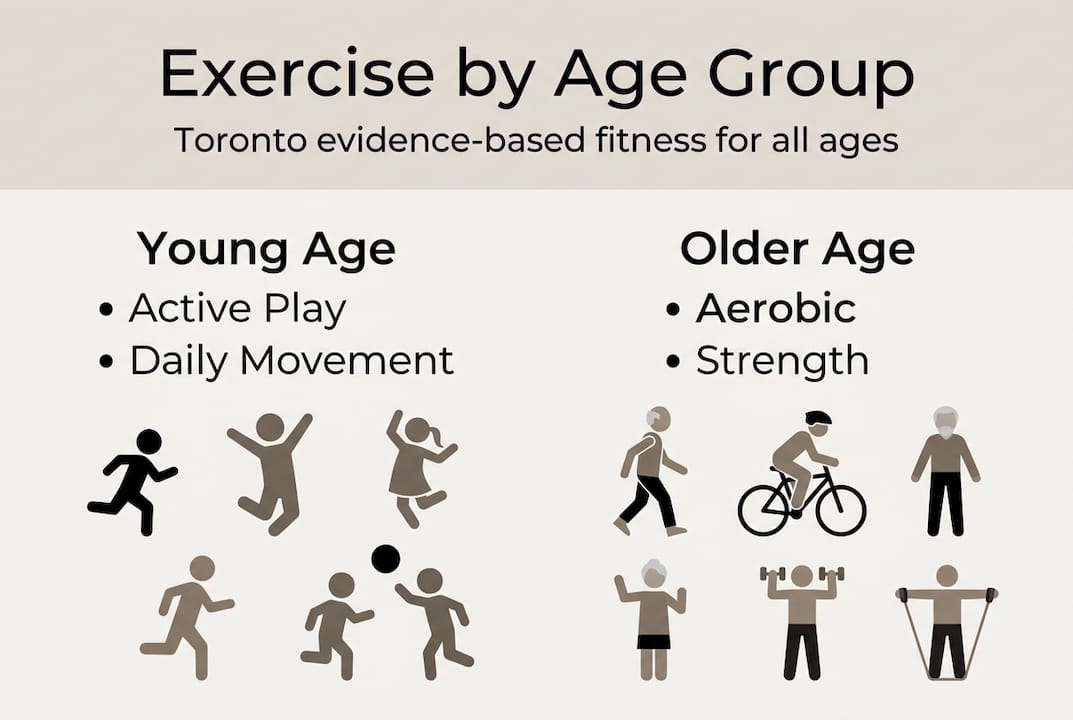
| Age group | Recommended weekly activity |
|---|---|
| Preschool (3 to 5) | Daily active play throughout the day |
| Children and teens (6 to 17) | 60 min moderate to vigorous activity daily |
| Adults (18 to 64) | 150 min moderate or 75 min vigorous aerobic activity plus 2 days of muscle strengthening |
| Older adults (65+) | Same as adults, plus balance activities to reduce fall risk |
These benchmarks come directly from CDC activity guidelines and are echoed by WHO physical activity standards. They are not rigid rules. They are targets that can be adapted for chronic conditions, injury recovery, or limited mobility.
For Toronto families, understanding family fitness benefits can make it easier to build routines that work for everyone in the household. Teens benefit from structured sport and active commuting. Adults often do well with group fitness classes or gym-based training. Seniors thrive with low-impact options like swimming, walking, or resistance training.
If you are recovering from an injury or managing a chronic condition, the key is not to wait until you feel “ready.” Start with what you can do and build from there. Access to quality Toronto fitness equipment also makes a real difference in how safely and effectively you can progress.
Pro Tip: If you are unsure where to begin, consult physical activity guidance from a qualified professional who can assess your current ability and set realistic milestones.
Types of exercises for a well-rounded fitness plan
Age-specific routines are most effective when they include a mix of exercise types. Here is how each category contributes to your overall health:
| Exercise type | Key benefits | Examples |
|---|---|---|
| Aerobic | Heart health, endurance, mood | Walking, cycling, swimming |
| Strength | Muscle mass, bone density, metabolism | Weights, resistance bands, bodyweight |
| Balance | Fall prevention, coordination | Heel-to-toe walking, single-leg stands |
| Flexibility | Range of motion, injury prevention | Stretching, yoga, Pilates |
For older adults, proper form and progressive overload are especially important. Rushing through movements or skipping balance work is where injuries happen. Slowing down and focusing on technique is not a step backward. It is smart training.
Here is a simple framework to build your balanced routine:
- Start with two to three aerobic sessions per week at a comfortable pace.
- Add two strength sessions, focusing on major muscle groups.
- Include balance exercises at the end of each workout, even for just five minutes.
- Finish each session with five to ten minutes of flexibility work.
- Rest and recover. Sleep and nutrition support every other step.
Using the right Toronto fitness gear can make each of these categories more effective and safer. It also helps to set fitness goals before you begin, so you have a clear direction and can measure progress. Working with Toronto fitness trainers is one of the most reliable ways to ensure your plan is both safe and personalised.
Pro Tip: For seniors or anyone recovering from injury, prioritise form over load. A lighter weight done correctly builds more strength and causes fewer setbacks than heavy weights done poorly.
Overcoming barriers and adapting fitness for all abilities
Knowing what to do and actually doing it are two different things. Barriers are real, and they deserve honest attention.
Common obstacles include:
- Physical limitations: Chronic pain, arthritis, or post-injury restrictions that make traditional exercise feel impossible.
- Mental barriers: Low motivation, fear of judgment, or past negative experiences with fitness.
- Environmental challenges: Cost, access to facilities, or lack of time in a busy Toronto schedule.
- Knowledge gaps: Not knowing how to modify exercises safely for your condition.
The data is both sobering and motivating. Sarcopenia progresses at 1 to 2% per year after age 50, meaning muscle loss accelerates if you remain inactive. Falls are the leading cause of injury for adults over 65. But regular activity significantly reduces both risks, along with mortality and chronic disease rates.
For those managing chronic pain or recovering from injury, exercise for chronic pain does not have to be intense to be effective. Gentle, consistent movement often reduces pain more reliably than rest alone. Toronto also offers excellent outdoor exercise spaces that make low-impact activity enjoyable year-round.
Adapting for chronic conditions means working within your current capacity while gradually expanding it. A trainer who understands adaptive fitness can make this process feel supportive rather than limiting.
“Some movement is always better than none. Your starting point does not define your ceiling.”
Pro Tip: If a full workout feels overwhelming, start with ten minutes. Research consistently shows that even short bouts of activity accumulate into meaningful health benefits over time.
Why true fitness goes beyond age brackets
We have seen something interesting at our Toronto gym: the most motivated clients are not always in the youngest group. Often, it is the 60-year-old returning after a knee replacement, or the 45-year-old training alongside their teenager, who shows the most consistent progress.
Age brackets are useful starting points, but they can also create unnecessary limits. When mixed-age groups train together, something shifts. Younger members learn patience and technique. Older members are reminded that strength is still available to them. Recovery stories become motivating rather than discouraging.
Fitness in Toronto is not just about meeting guidelines. It is about building a community where every ability level is respected and every starting point is valid. That perspective changes everything.
Supporting your Toronto fitness journey with inclusive resources
You now have the knowledge. The next step is finding the right support to put it into action.
At Striation 6, we work with Toronto residents of all ages and fitness levels, from complete beginners to seniors and those rebuilding after injury. Our Toronto gym membership gives you access to quality equipment and a welcoming community. Our personal trainers in Toronto design individualised programmes that meet you exactly where you are. And our nutrition coaching ensures your food choices support your movement goals. Start with a free trial and see what inclusive fitness actually feels like.
Frequently asked questions
What makes fitness for all ages different from typical workouts?
Fitness for all ages adapts activity to individual abilities, ages, and health status, following evidence-based guidelines to support prevention and independence rather than applying a single standard to everyone.
How much exercise is recommended for seniors in Toronto?
Seniors should aim for 150 minutes of moderate aerobic activity per week, plus strength and balance exercises, with modifications as needed for chronic conditions or injuries.
Can fitness routines in Toronto be adapted for injury recovery?
Yes, routines can be tailored with guidance from trainers and health professionals, focusing on proper form and gradual progression to prevent further injury and support safe recovery.
What are the benefits of staying active at every age?
Regular physical activity reduces chronic disease risk, supports mental health, and preserves independence, making it one of the most valuable habits you can build at any stage of life.
Recommended
- Why family fitness matters: 3 key benefits for Toronto
- Fitness equipment benefits for your Toronto health journey
- Outdoor Exercise in Toronto | Tips for Summer Exercise | Striation 6
- Winter Workouts in Toronto: 3 Tips to Stay Consistent | Striation 6 Toronto Gym
- Why oral health matters: your guide to total wellness – Scandi Gum

Diamond-Level Toronto Personal Trainer & Co-Founder of Striation6
I help people experiencing pain and who might confused or concerned about how to exercise in safe, effective manner using Muscle System Work and providing customized, fun and effortful exercise that makes bad stuff in your body feel better and the good stuff feel great.
As the founder of Striation 6 and an Exercise Professional with more than 20 years of experience, it is important to me that I set the example of our Mission: to help as many people as possible feel, function, look and live better through exercise.